

Stoicism, Suffering, and What It Means to Stand Your Ground.
Vegeta is the reason I love the entire Dragon Ball Franchise. Like most, I grew up with the Dragon Ball animes, I devoured all the mangas, deep dived into all the universes and arcs, even the most unfortunate ones like Dragon Ball GT, and I never fell off that ship… all because of Vegeta.

I know it is strange for a little girl of six (I was way too young to watch this, but that another story) to immediately fell in love with the bad guy and antagonist of the anime, especially when the Dragon Ball universe starts and centers around Goku, freshly orphan baby saiyan, dropped on earth after his entire race is exterminated by Frieza.
I know that Vegeta was (and still can be) cruel, vicious, cold, murderous and deeply flawed. He killed innocents (still remembered being traumatised by what he did on Namek), he put way too much important in myths about the Super Saiyan (Those who saw the first and original Broly movie know what I’m talking about), and it can be very callous about other people’s lives and wellbeing, especially innocents and fragile people. He can and will betray you if you are an obstacle to his path of greatness and he’s selfish, to an hardcore degree.

At least that how he started.
So why did I liked him from the get-go? Why did I relate to him the older I got? Why do I think he is the most philosophically rich anime character of the entire franchise?
Let’s pick him apart so you can see what I see in him:
1 — Vegeta and Epictetus: The Prince in Chains
Before Vegeta is anything else, he is what Epictetus was: a sovereign in chains. Epictetus was a slave and philosopher of Nicopolis. His teachings explains that true freedom lies not in status but in what cannot, (and should not) be coerced: our judgments, our assent, our inner stance toward fate. As we know, Vegeta is born a prince, the prince of all Saiyans, the ultimate warrior race. His race is however subjugated by Frieza’s rule and his Frost race family. Frieza forced Vegeta’s father to rendered him as his property, a royal asset in Frost empire. And then Frieza blow up Planet Vegeta and effectively exterminated the entire Saiyan race… saved a lucky few.
Vegeta’s lineage is reduced to an entry on someone else’s balance sheet, a tyran, far worst than anything his father was or he could be. Remember that he was a toddler when all of this happen. The ages of the characters in the DBZ universe are a little fuzzy and alternate with the changes each film and show makers introduce with time.

But Vegeta was young, younger than Trunk, his own son of seven in DBZ, when Planet Vegeta was destroyed. For me, he was between four to seven. And here lies the structural trauma that explains the man he becomes: his arrogance is the best armor he could build because he grew up surrounded by the men of Frieza Force, the Cold Force, the most inhuman and catastrophic army of the universe at that time.
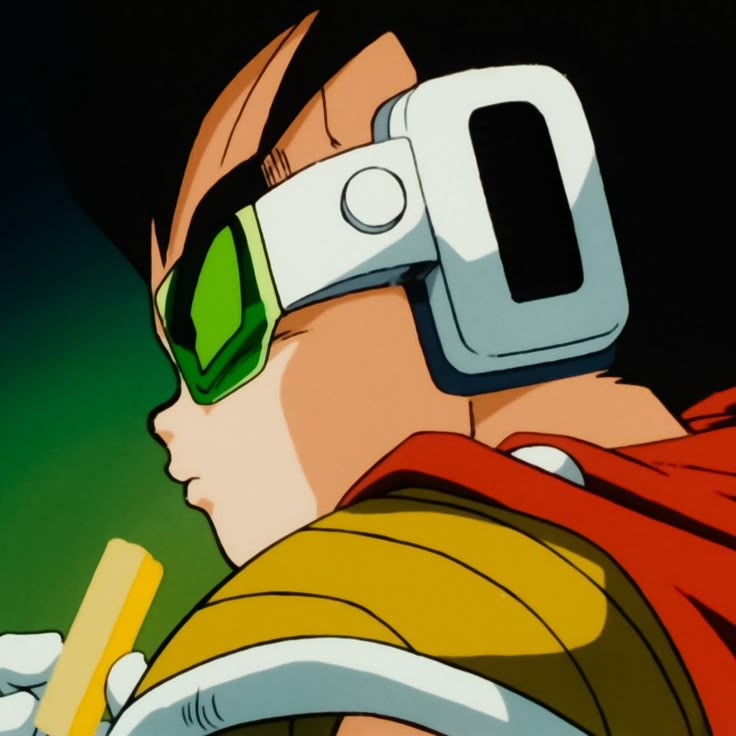
Vegeta’s rage is a fuel, a bottomless pit of will to repossess what was stolen from him, and his obsession with strength is align with pure Stoic structure: a quest to find something within that can’t be dominated again. My conviction is that Epictetus would recognize Vegeta’s posture as a soul that senses its own inviolability but has confused external power for inner freedom, a prince trying to philosophize with his fists because no one ever taught him that his real kingdom, his true power, lies is his ruling faculty, something Vegeta really struggles with.
2 — Aristotle: Megalopsychia, or The Virtue of Knowing Your Own Worth
In DBZ is very easy to read Vegeta’s pride as pure dumb arrogance.
But for some reason, I never could.
When I studied the works of Aristotle, one word in Nicomachean Ethics stood out for me despite the fact that does not translate cleanly into English or French. The word is megalopsychia “great-souledness”, sometimes rendered as magnanimity. Aristotle describes it as a specific kind of person: the one who knows, accurately and without false modesty, what they are worth and who expects to be treated accordingly. That mindset is not described as a flaw in Aristotle’s moral framework, it is view as a virtue. In contrario, the failure, for Aristotle is in the both direction: someone who overestimates their worth is vain; someone who underestimates it is small-souled, almost cowardly. The megalopsychos, the great-souled person, stands exactly where they should stand.
I think Vegeta is what Aristotle would recognize as a megalopsychos.
A scarred, twisted, mutilated one
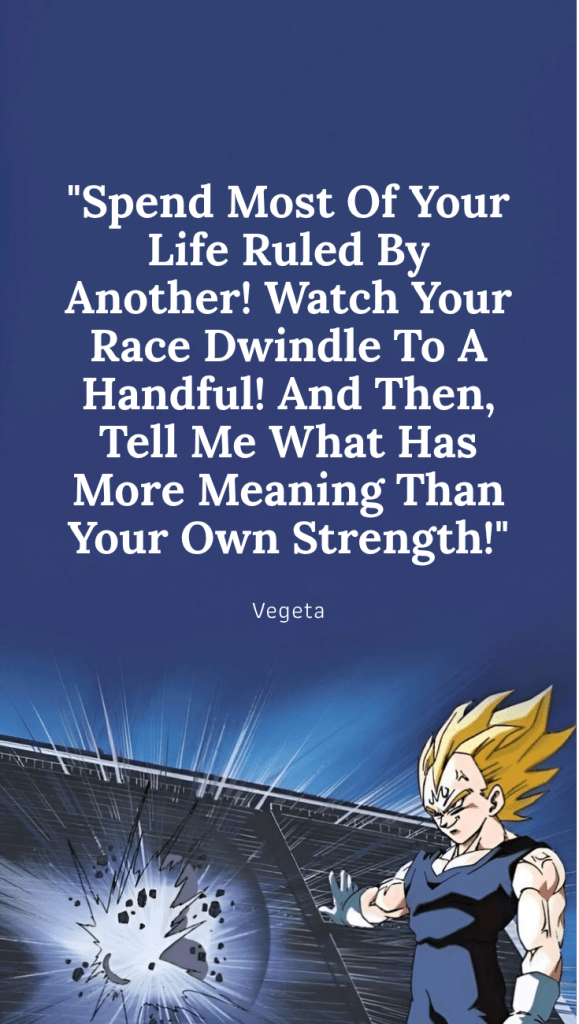
The Frozen Army and Frieza changed the megalopsychos nature of Vegeta: a “great-souled” man whose sense of his own worth survives even when every external marker of that worth has been stripped away. You cannot tell me that does not represent Vegeta to the T: everything that built his self-worth and self-esteem has been shredded: first under Frieza and then in the shadow of Goku. Vegeta lives in a permanent state of subjugation: he said it himself: his royal lineage is reduced to a joke, his people are annihilated, his power is always… almost-enough which is a soul crushing for him.
Aristotle says that true greatness of soul is not arrogance but accurate self-estimation: the man who knows he deserves honor and refuses to counterfeit humility to appease the small. I want you to see Vegeta’s infamous pride under this prism: suddenly, that pride is not a character flaw to be tolerated or cured but a true survival strategy and a virtue: the deliberate construction of an identity that cannot be owned.
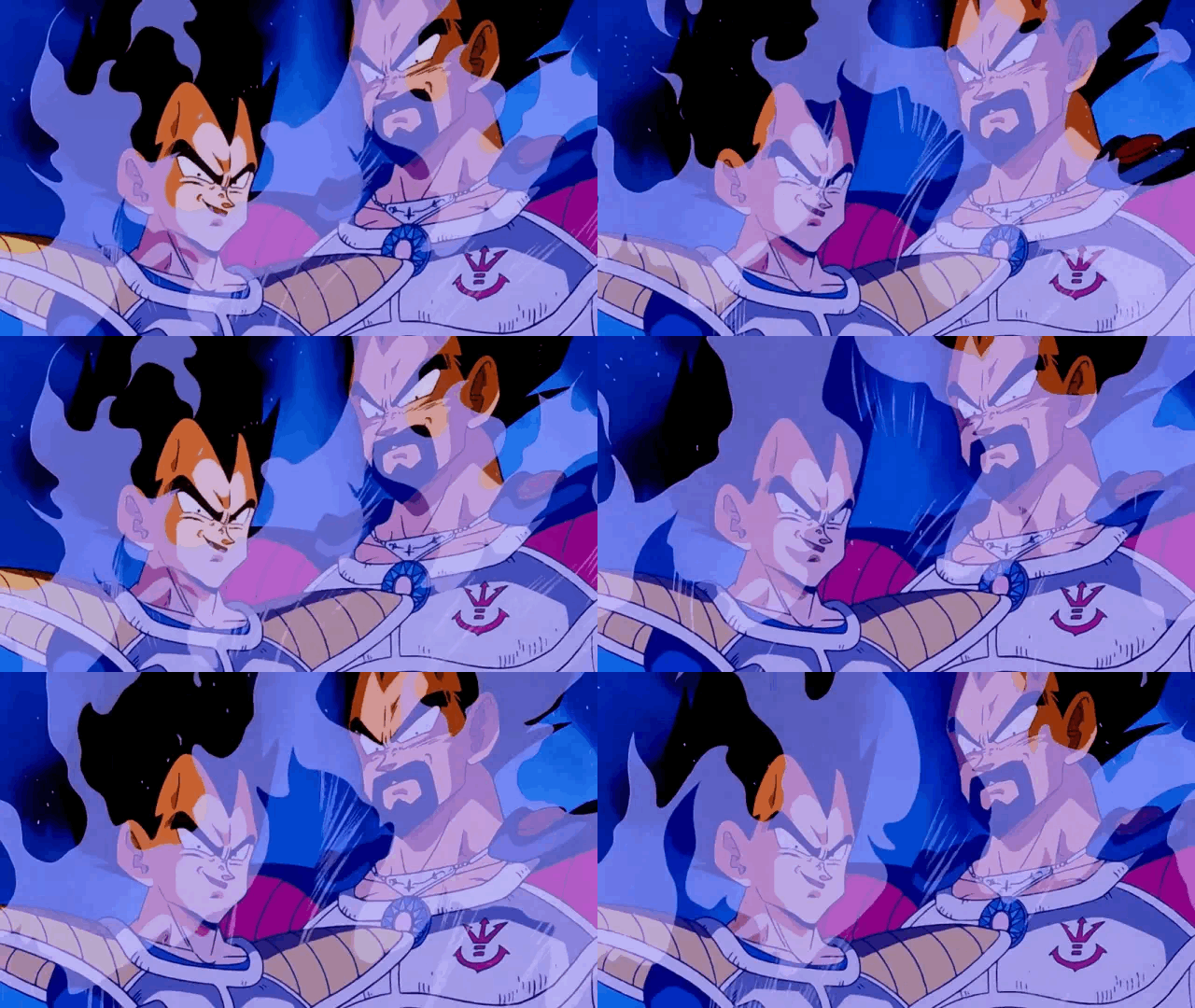
Yes, Vegeta clings to the title “Prince of all Saiyans,” but he’s doing so to reasserts a metaphysical rank the universe cannot ratify but also cannot erase, and that stubborn insistence on his own value is what keeps him from becoming merely another of Frieza’s weapons or Goku’s sidekick slash supporting cast. I’ll die on this, fight me in the comment if you dare.
3 — Seneca: Suffering as the Only Legitimate Path
For me, Aristotle gave Vegeta the why of his pride.
And here, I’ll explain that Seneca gave the how of his endurance.
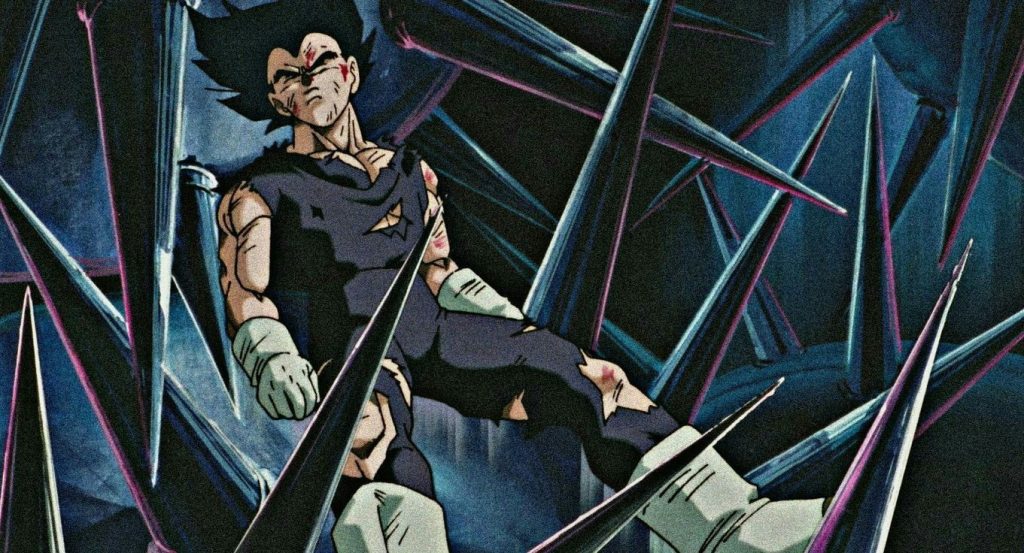
As a kid, I always loved Vegeta’s training scenes, much more than the Goku’s ones. As an adult, I reconigned that those scenes are where Seneca takes over the narrative. The gravity chamber, the torn muscles, the self-inflicted isolation… none of this is random shōnen excess crap; it’s the direct and logical consequence of a man who has accepted suffering as the only honest currency of his own growth.

Yes, Aristotle gives us the framework of Vegeta’s megalopsychia, his fierce knowledge of his own wort, but it’s Seneca’s philosophical view that who demonstrates what that pride does under pressure: it chooses deliberate and ritualistic pain.

What I love is that Vegeta refuses the comfortable lie that power or dignity can be reclaimed without cost. Whatever he does to himself to get to the top, he refuses to do it cheaply.
Lucius Annaeus Seneca wrote, among many things, that the path to virtue runs exclusively through difficulty. Per aspera meaning “through hardship”. Not around it, not in spite of it, but through it, as the only legitimate route.
Suffering, in Seneca’s moral framework, is not a horrible obstacle to becoming who you are meant to be. It is the mechanism. Pain is not incidental to the formation of one character. It is the material the character is made from.
Watching Vegeta train is literally watching this philosophy being translated with a body. I know that it might be peculiar for a young woman to feel this way, especially in this day and age where Vegeta and his mindset is unfortunately associated (as is Tommy Shelby’s) to the toxic manosphere. But Vegeta is not made for people limited by their own hatefulness. He’s made for anyone willing to go above and beyond for their own greatness because they believe in themselves.
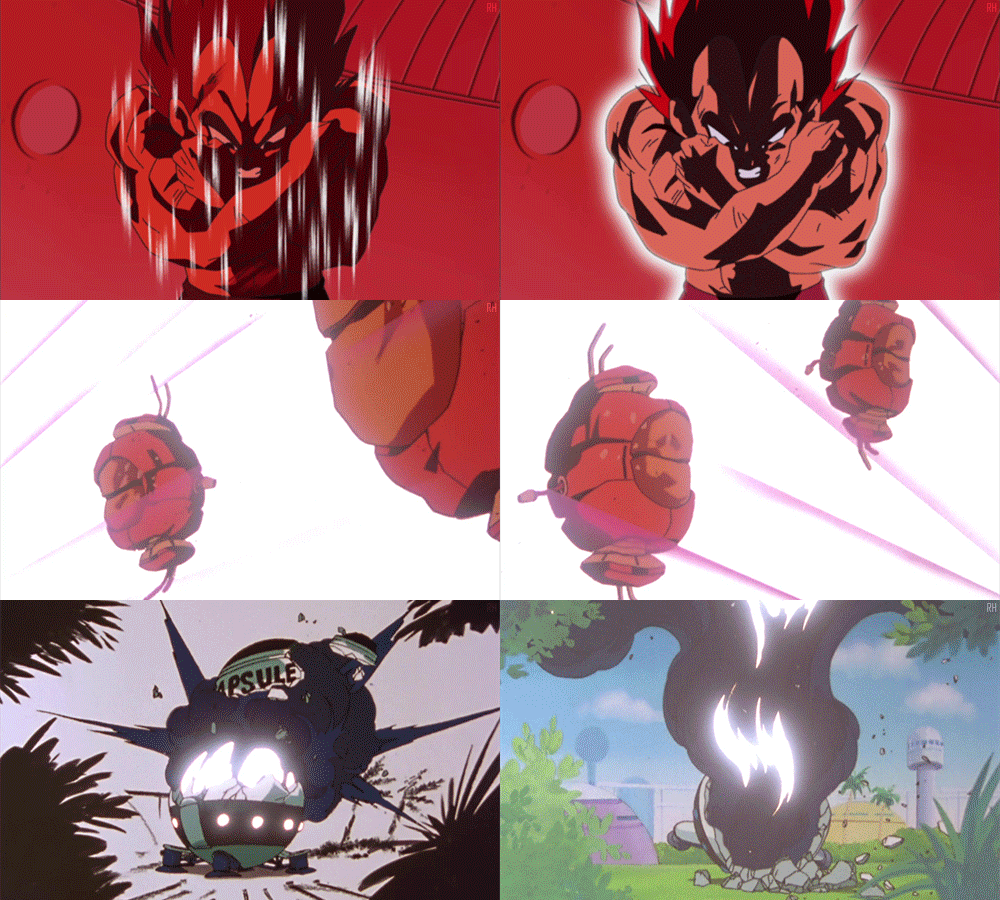
The gravity chamber sequences are like theological statements. Vegeta does not train to maintain his power, he trains at levels designed to break him, consistently and deliberately, because anything less would be an insult to what he is trying to become. More. He pushes the gravity to hundreds of times Earth’s standard. He bleeds. He passes out. He gets up. He increases the gravity. And there is no one with him, no external cheering, no audience. His suffering is entirely self-administered and completely intentional because Vegeta has internalized, at a structural level, that comfort is the enemy of transformation. Could Seneca have written a better allegory for his ideas?

But, I should nuance something: Vegeta’s path through suffering is not basic masochism, it goes way beyond that, and it because of the purposefulness behind it. Seneca himself was not interested in suffering for its own sake and we know that pointless pain is just damage. In his work, Seneca described directed suffering meaning hardship chosen in service of a clearly understood goal, endured with full awareness of why it is necessary. Vegeta is not punishing himself. He is building himself, with the only two materials he trusts: endurance and resistance.
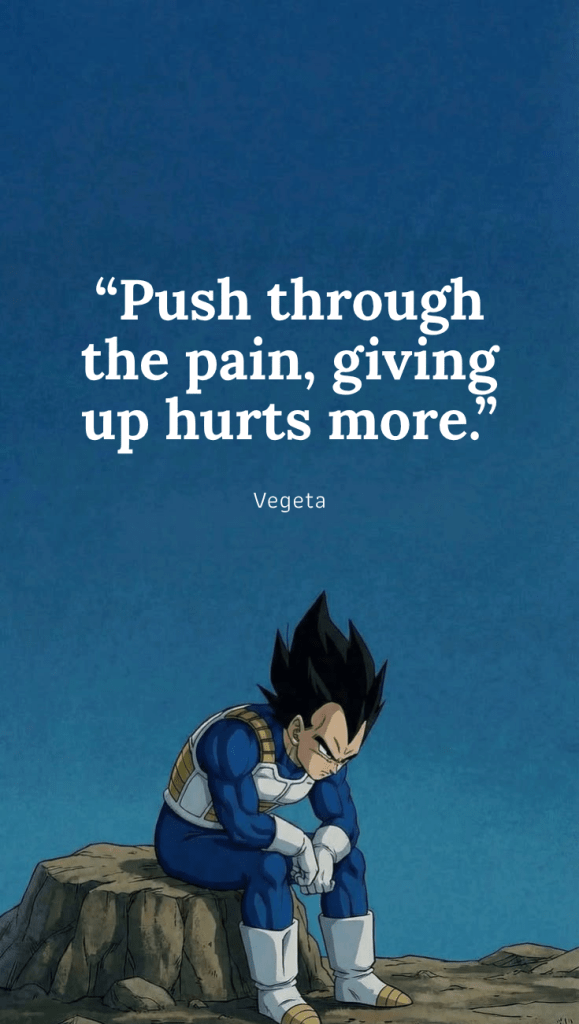
I’m not going to lie, Vegeta’s mindset is one of the most effective way to get me to the gym. I would also argue that it is through his endurance that is pride becomes virtuous: for him, to stop training when it hurts is a form of self-betrayal, a concession that he is less than what he know he is.
So, his suffering is not separate from his megalopsychia, it is its proof of concept. Every training session Vegeta is undergoing screams without words:
I am worth this much effort. I am worth this much pain.
Seneca calls it virtue. I call it one of the most stunning traits about Vegeta.

4 — Nietzsche: The Will to Power and the Weight of Ressentiment
Nietzsche‘s realm of work about ressentiment locks into place the architecture of Vegeta’s pride. Of all the philosophical theories I can link to my favorite character, this one is what makes the most sense to me…and also where Vegeta hurts the most.
Friedrich Nietzsche’s concept of the will to power is one of the most misunderstood ideas in the history of philosophy, largely because it is often reduced to its most simplistic form: the desire to dominate others, to win, to be on top. I hate that interpretation even if I can understand how people got to it. But it is very reductive and, while that is open to debate, I think it is the opposite of what Nietzsche actually meant. I think the will to power is not primarily directed outward but mostly directed inward. It is the drive to become, to exceed the previous version of yourself, to refuse inertia, to push against the limits of what you currently are and shatter them.
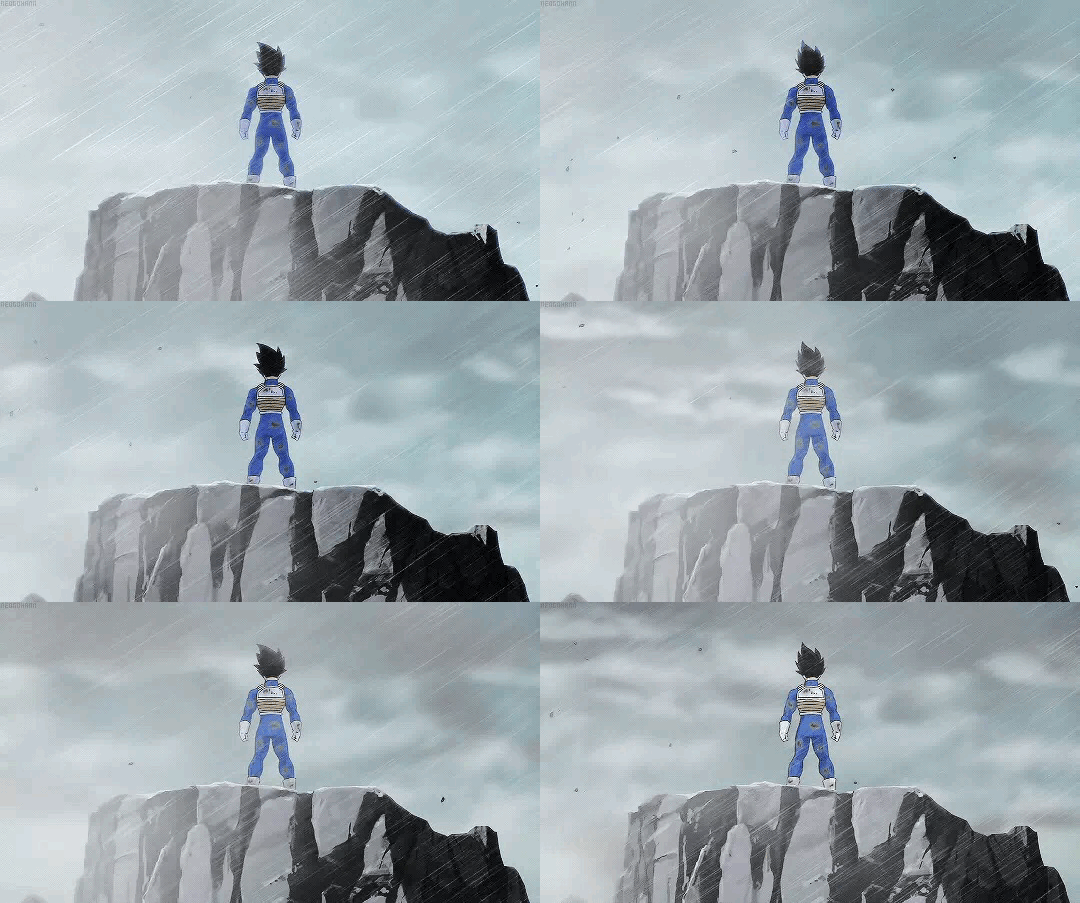
So by default, the Nietzschean ideal archetype, the Übermensch, is not a conqueror of other people. He is a conqueror of himself.
And that is where this theory collides with Vegeta’s entire essence with the force of a thousand suns.
And by that definition, Vegeta is the most Nietzschean character in the entire Dragon Ball franchise. Not Goku (I mean, come one…) but Vegeta.
From what I know about Goku after watching and reading decades of DBZ, he fights because he loves to fight, because the next strong opponent is its own reward, because battle is, for him, a form of thrill. And in Nietzsche’s body of work, this state of being ressemble most to what he calls the spirit of play.

Vegeta is different and I love him all of more for it. He is not merely trying to surpass Goku; he is trying to redeem an existential insult. Every Goku victory is a metaphysical offense against his self-conception as the rightful apogee of a Saiyan being. Every transformation and every power level is not a destination but an forecoming action he places on himself to go further. The gravity chamber is there. The brutal training regimens are there. There is no ceiling he cannot break. This is will to power in its truest philosophical form: the relentless, self-directed drive toward self-overcoming.
The will to power explains why Vegeta cannot stop, even under the new canvas in his life as he evolves: domesticity, fatherhood, and peace… all those elements nested themselves into new arenas for his self-overcoming. And of course, this is Vegeta, he does not train to be “good,” he trains to be worthy of his own image of himself.
However there is ressentiment.

And that ressentiment explains why there is so much pain for him. I remember feeling terrible for him during every scene he cried because of what he perceived as the limitations of his own body, every time Goku overpowered him, every time he lost.
We all got to admit that being forced to watch a low-class warrior become the living refutation of his aristocratic pride, made Vegeta converts his humiliation into fuel, and then into an “indestructible engine.” From his perspective, Goku isn’t a friend or rival; he is the eternal glitch in the system, the universal unfairness that guarantees he can never feel complete.
The world ressentiment is french, like myself, and Nietzsche kept it deliberately as is and explained it as the psychological condition of those who define themselves against another rather than from within themselves.
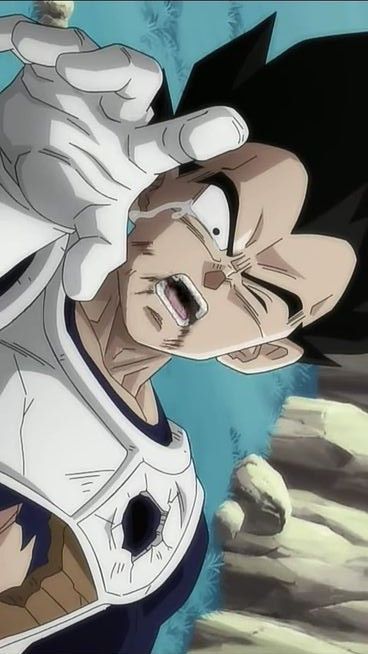
So, it is quite literally the inversion of the will to power: instead of generating your value from the inside, when you feel ressentiment you generates it reactively, by measuring yourself against someone else and finding the gap intolerable. It is corrosive precisely because it looks like drive, but it’s not. It presents itself as ambition, but it’s not. It’s a constant bleeding wound.
I will be honest about this, I think Vegeta will always carries ressentiment toward Goku for the entire timeframe of the franchise, no matter his growth, and pretending otherwise would be a dishonest reading. Forever trying to surpass Goku, being second at every new transformation he achieves first; those are wounds that haunts Vegeta’s entire identity.
However, I don’t think the ressentiment completely define Vegeta. At his worst, Vegeta is reactive, measuring, wounded. At his best, Vegeta is the best, best more often than people give him credit for, and that is purely Nietzschean in the original sense: self-directed, internally motivated and indifferent to anyone else’s scale.
Viewing Vegeta through Nietzsche’s prism allows me to witness his slow and extraordinarily painful process of converting ressentiment back into genuine will to power…. of learning to want his own becoming rather than the defeat of someone else’s.

And that process is never complete and probably will never be. I honestly don’t think it’s meant to be anyway. But the fact that Vegeta keeps trying? That he keeps returning to himself, keeps pushing, keeps fighting, keeps refusing to collapse the will to power into mere rivalry? All of that is, to me, the philosophical core of why he is worth my undying admiration and love.
It was Nietzsche wrote that “what does not kill us makes us stronger” right? I love Vegeta took it personally. He truly is the best character of the DBZ world.
5 — Hegel: The Master Whose Mastery Became Hollow
In the Phenomenology of Spirit, Georg Wilhelm Friedrich Hegel describes what has come to be known as the Master/Slave dialectic, one of the most quietly devastating things you can apply to a fictional character if that character happens to be a Saiyan prince.
The argument, stripped to its essential movement, goes like this: two consciousnesses meet and enter into conflict. One dominates; one submits. The dominant one becomes the Master. The submissive one becomes the Slave. On the surface, this looks like a stable and rightful hierarchy, the Master has won, the Slave has lost, the order of things is safely established.
But Hegel does not stay at the surfaces of those things.
When Frieza dies and Goku keeps winning, Vegeta’s Nietzschean engine of ressentiment collides with an Hegelian problem: his entire being-for-itself was built on being recognized as “Prince of all Saiyans,” as the strongest of them all… by an order that no longer exists.
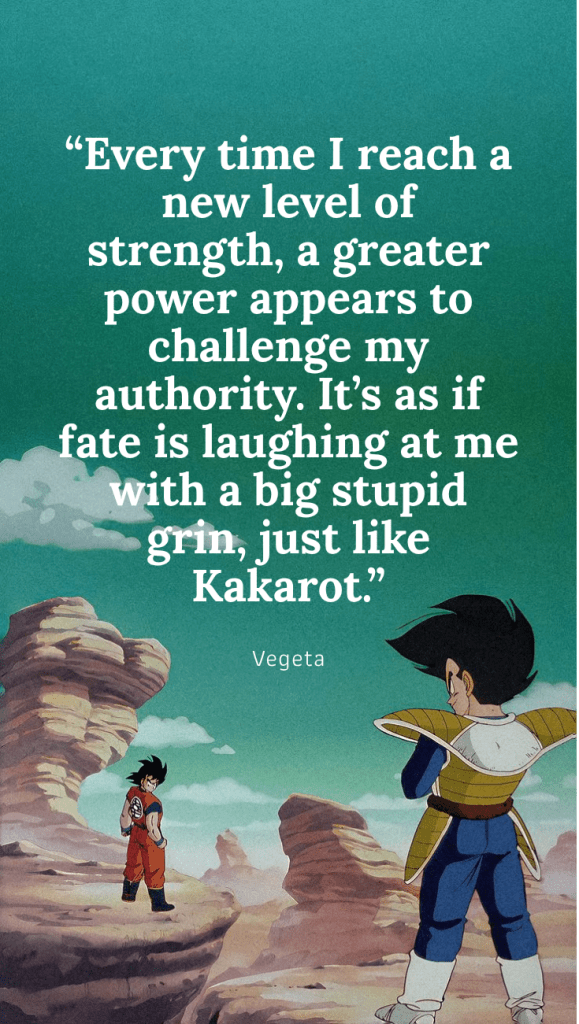
In Hegel’s terms, the master discovers his mastery is hollow the moment the slave surpasses him; the recognition he demanded now comes back as a mirror he cannot bear to look into. So every loss Vegeta suffers because of Goku is not just a tactical defeat but a metaphysical one, a negation of the very narrative that made his pride intelligible.
But, for me, it is the inversion that makes the dialectic so unsettling. The Master, having established dominance, no longer needs to develop. He is recognized. He is at the top and there is nowhere to go and nothing left to prove, so he stops.
The Slave, on the other hand, has no such luxury. The Slave must work, must adapt, must transform the world through labor and effort because survival demands it. And through that labor, through the constant, grinding and necessary engagement with resistance, the Slave is actually the one developping. Changing. The Slave becomes. The Master, in his stillness, stagnates. And then, what happened to the recognition the Master fought for?
It starts to progressively worth less because it is diminished, and the recognition of a diminished being cannot sustain a consciousness that requires genuine acknowledgment to feel real.
The Master’s mastery becomes hollow and he has no one to blame but the logic of his own victory.
That is the Hegel principle we can apply to Vegeta, especially as he was, at the beginning of Dragon Ball.

I viewed Pre-Namek Vegeta as the unambiguous Master. He was the Prince of all Saiyans, the highest power level of his race, the dominant force in every room he entered, every planet he conquered. Goku, by every standard in their shared universe, should have been the Slave: lower birth class, no formal (Saiyan) training, raised by humans and totally ignorant of his own origins. I mean, the hierarchy between them was not even a question, it was a setting.
But then Goku worked, trained, transformed and surpassed.
And when I watch this unfold through an Hegel’s lens, I understand that this outcome is not an accident or an injustice, no matter how Vegeta feels about it. It is structurally inevitable. The Slave who is forced to develop will eventually exceed the Master who was not. it’s fate. It logic. It’s obvious. Goku did not take anything from Vegeta. The dialectic simply ran its course. The hierarchy produced its own undoing, exactly as Hegel said it would.

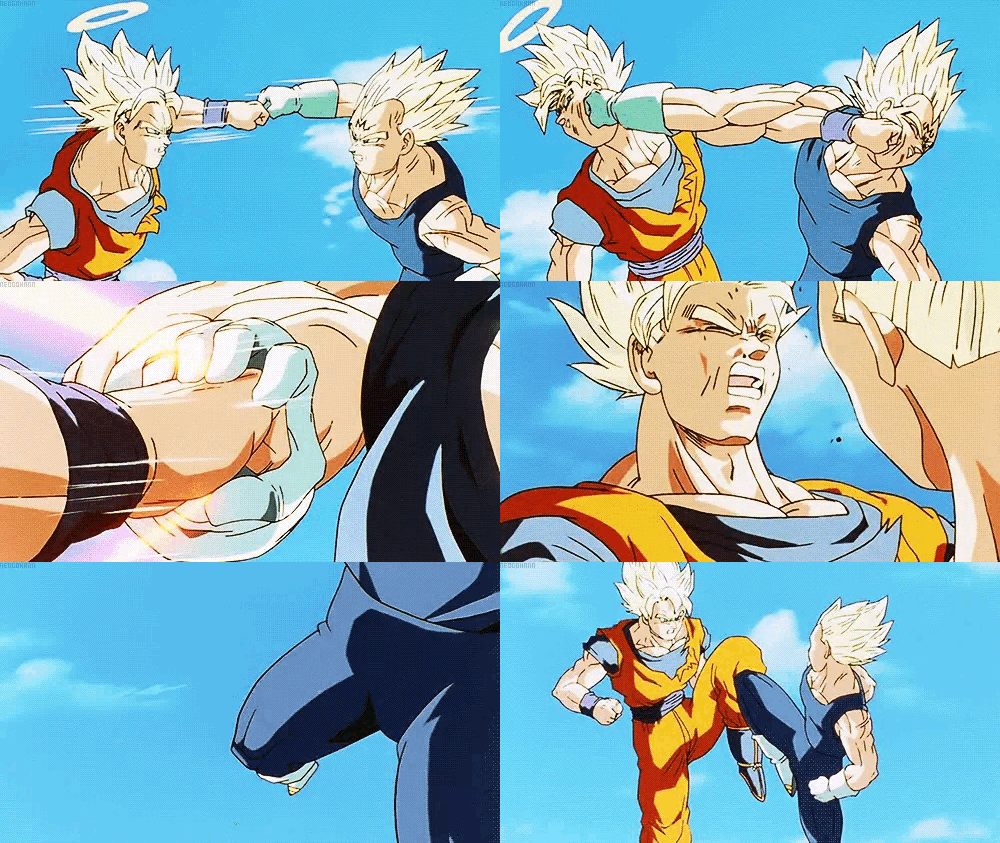
To me, this part of Vegeta’s arc is the most painful to watch, especially because I relate to his character so much and and have always been on his side. I think Vegeta understands, on some level, what has happened. Of course, DBZ does not introduce the vocabulary of Hegel’s dialectic, but I feel that everything Vegeta experiences through his body, in every fight where he pushes himself to his absolute limit and finds Kakarot already waiting on the other side… I believe he feels the structure of this dialectic.
However, there is a ray of light in this darkness: what Hegel does not fully account for is what happens to a consciousness that refuses to resolve. And that is the core of Vegeta. And this is where he transcend the dialectic really: Hegel’s theory offers a synthesis: the Master and Slave top their opposition into something new. Vegeta does not synthesize. This contradiction does not apply to him, on the contrary, he stands inside it, endures it, and keeps moving anyway. Whether you see it as a limitation or a form of heroism depends entirely on how you read him.
I, of course, have always read it as heroism. And if Hegel would have view it as stubbornness, I think we would be both right.
6 — Marcus Aurelius: The Long Road to Internalized Worth
We went over the collapse and rebuilt of Vegeta’s identity through Hegel’s lens. Now is the time to analyse Vegeta through Marc Aurelius’s Meditations.
First, to understand why I linked those two, you must remember that Marcus Aurelius did not write the Meditations for publication.
That’s very important, it screams Vegeta Core to me. The Meditations are a private document, it’s the intimate insight of a Roman emperor writing to himself, in the quiet hours, about how to be better than he had been that day. There is no audience, no performance, and no external validation sought. His entire project is predicated on a single conviction: that the only legitimate source of a person’s worth is internal, and that the moment they begin measuring themselves against the world’s recognition of them, they have already lost something essential. For Marcus Aurelius, the Stoic ideal was not the absence of ambition, it is the presence of a self so grounded in its own values that external judgment like praise, contempt, victory or defeat, simply cannot reach the core of it.
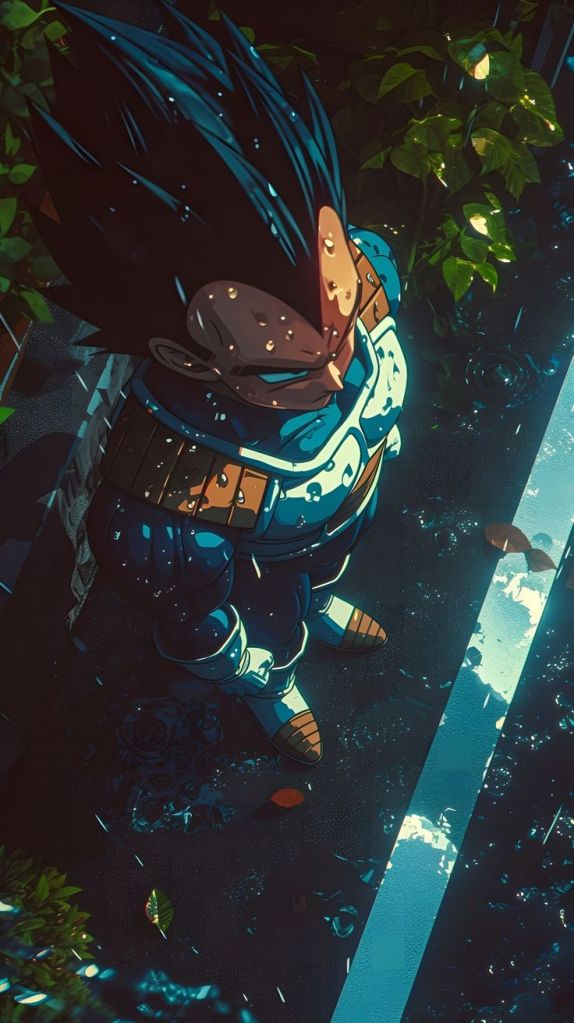
Vegeta did not start there, we already went through this, as a matter of fact, he was the perfect opposite of that. When he came to earth, everything about him was oriented outward: toward recognition, toward dominance, toward being seen as the strongest, because being seen like this was the only confirmation he had that the hierarchy he was given at birth was real.
But with time, it’s impossible to ignore that Vegeta’s path bends very slowly and very painfully toward something that looks uncannily like Marcus Aurelius’ hard‑won indifference.
The man who once needed the universe to acknowledge him as “Prince of all Saiyans” begins, kind of against his will (at first), to relocate worth from the metaphorical scoreboard to the self.
And that is what is crucial here: across their twelve books, is a practice, what the Meditations describe is not an achievement. Self-mastery in the stoic tradition is not a destination you reach and then inhabit permanently. It is something you return to daily, through deliberate effort, because the world is constantly offering you reasons to abandon it. Duty over desire. Discipline over reaction. The cultivation of indifference, not apathy, but the specific Stoic apatheia, the freedom from being governed by what you cannot control, as a daily, renewable commitment.

Through a very long and very brutal process, Vegeta got there.
It doesn’t happen in a single battle or speech; it happens in the quiet humiliations: admitting Goku surpassed him, choosing his family over Babidi’s promise of restored cruelty and murder rampage, fighting not for glory but to offer Trunks a safe future… I believe Marcus would describe this as the long discipline of the inner citadel: Vegeta learning to treat power, rivalry and even Saiyan pride as non-sovereign parts of his soul. By the time he sacrifices himself against Buu, one of my favorite scene, his pride has inverted: it’s no longer “I am worthy because I dominate,” but “I am worthy because I govern myself.” This is the pivot from ressentiment to reconstruction, from shattered prince to self‑authored soul.
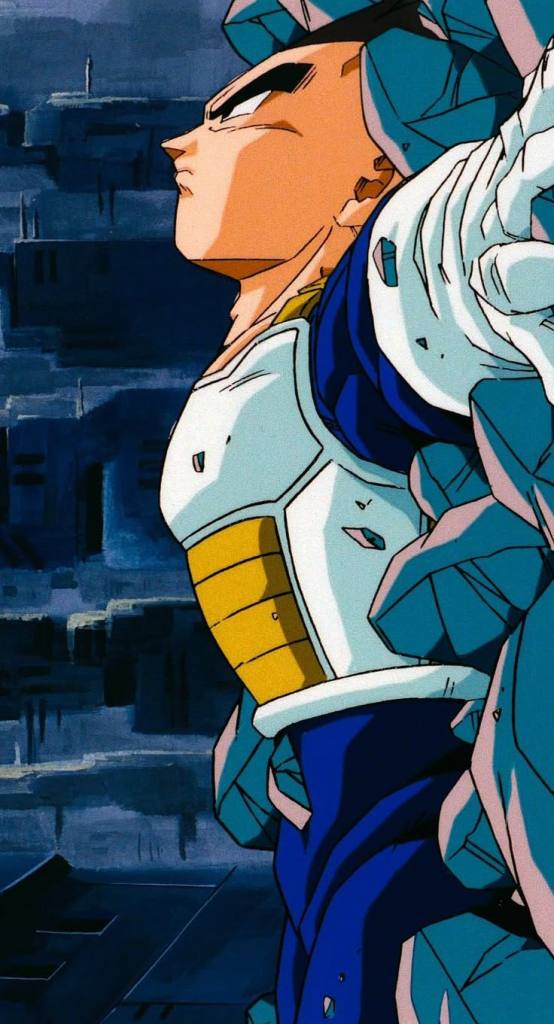
Again, it does not happen cleanly or suddenly. There is no single moment where Vegeta resolves into Marcus Aurelius and stays there. What there is instead is a gradual, interrupted, and quite frankly agonizing process of learning to locate his worth somewhere the universe cannot reach it. Through the franchise, we can see that his obsession with surpassing Goku slowly, very slowly, gives way to something quieter but more devastating: the drive to surpass himself.
Those little and subltes moments are the one I find most Aureliean in the entire franchise, not a specific battle but this quiet and beautiful evolution. Vegeta no longer need Goku to lose in order for his own victories to count. That shift might be small on screen but it is monumental for a fan like me.
The thing that strikes me the most about the both of them, emperor and prince, is that neither of them managed to reach this indifference through comfort or ease. Marcus Aurelius was governing an empire in perpetual crisis, managing plagues and wars and the specific loneliness of absolute power. Vegeta was doing something similar structurally: he was holding together a sense of self under impossible conditions, conditions specifically designed, to fail, by circumstance and by the logic of his own twisted universe. Seneca said suffering was the path to virtue. Marcus Aurelius described what virtue looked like once you got there which is not triumph, not recognition, not the defeat of your rivals but the quiet, daily and renewable choice to be answerable to yourself alone.
Vegeta achieved it. Imperfectly and non-linearly, but he did it nonetheless.
7 — Sartre: To Be Seen Is to Be Diminished
Let me preface this by stating that I love Being and Nothingness by Jean-Paul Sartre. That being said, there is a moment in it that has always left me… unsettled.
Sartre is describing a person alone in a room, doing something they would not want witnessed. Then, there is a sound, footsteps in the corridor and the sudden possibility of a gaze from outside. In that instant, before anyone has even entered, before any actual eye has fallen on them, the person changes. They become an object, in the philosophical sense. The gaze of another consciousness does not merely observe you. It fixes you. Encage you. It assigns you a nature, a definition, a set of codes in someone else’s world that you did not choose and cannot fully control. To be seen, in Sartre’s framework, is to be partially captured, paralyzed. The freedom you had when you were alone? That radical, unlimited freedom of a consciousness with no witness, is suddenly and irrevocably compromised.

Sartre called this le regard, meaning “the gaze” in english. He considered it one of the fundamental structures of human conflict.
Analyzing Vegeta through a Sartrean lens, is understanding that his final evolution isn’t about power level but about surviving being seen. I already explained in six parts how his entire life has been a project of refusing the gaze: from the armor, to the scowl, to the cultivated cruelty, everything is a way of staying on the side of subject, never object, and who could blame him, he was as much as prince as he was a slave.
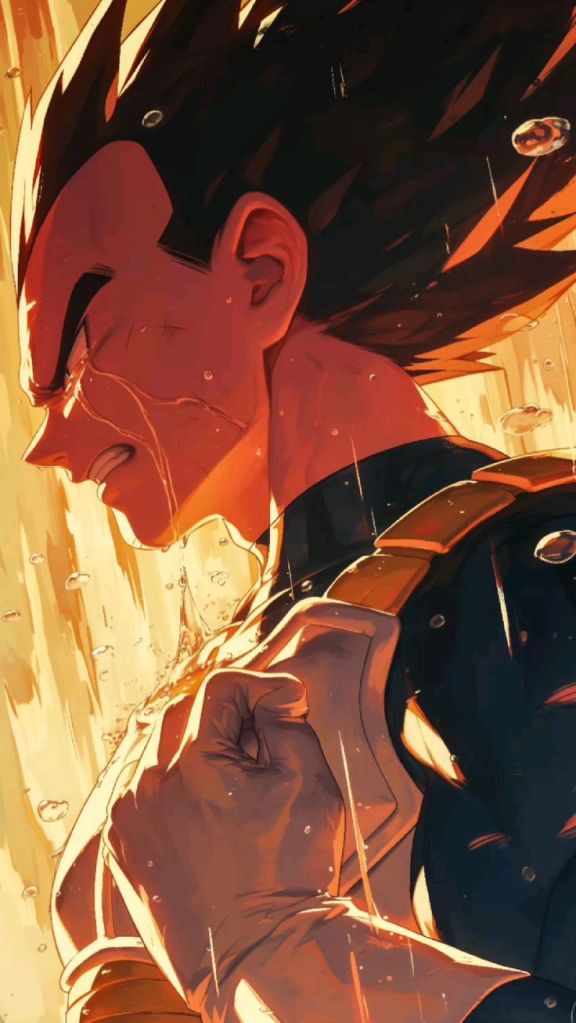
The Vegeta we discussed in previous sections has his identity forged in subjugation and converted into pride. His practice of suffering transforms his pain into proof of worth. He is a philosophical fortress and Nietzschean in its self-direction, stoic in its discipline, Aristotelian in his grounded conviction of his own value (and he does have tremendous values rooted in truth: he survived the genocide of his people, he survived Frieza, he survived the Planet Trade Organization, he survived the Hegelian collapse of his masterdom, he survived the long humiliation of watching someone he considers his inferior consistently exceed him… he survived what should have killed him in every sense of the word.) Vegeta’s fortress has held strong, not without damage and not without cost, but it has held. I believe it has held precisely because it was sealed, because nothing from outside could reach the core of it without Vegeta’s permission.
Well… that when love entered the equation. And love requires permission. That is big problem for Vegeta.
To be loved is to be looked at, and for someone who has built his identity as a fortress, that look feels like invasion, dare I say, a violation, an x-ray that could reveal how cracked the “Prince of all Saiyans” is beneath the heaviness of this title.
Bulma is much more threatening than any Android or monster because she does just look at him, she sees him. And she does not fear him. Therefore she cannot be kept at a distance. Also, her gaze doesn’t flatter his pride, on the contrary; it humbles him sometimes, but more importantly, it humanizes him. Sartre set the stage for us to understand that Vegeta’s reluctance to love is not the standard cliché tsundere posturing: it’s a structural ingrained terror. The moment he allows himself to be seen, he has to risk being smaller than his legend.

I think that to love someone truly, you must see them truly, you must see the ugly and twisted parts, the doubts, the needs, the places where pride, shame, hatred and loss left in ruins, and the suffering that has yet to be hardened into endurance.
For Sartre, love is the most radical act of self-exposure a person can perform, because it extends the invitation not to a neutral observer but to another consciousness with its own freedom, its own gaze, its own capacity to define and diminish and misread what it sees.
I’ll be honest, this is terrifying to me, but that the topic for another article. However, if it’s terrifying for me? For Vegeta, it’s nothing less than catastrophic.
And yet, he stays. He chooses to stay.

This is like the Sartrean scandal of his emotional arc. A man who has structured his entire existence around the control of who gets to define him, a man who has fought wars and has endured unimaginable suffering rather than cede that control to anyone, chooses to remain in proximity to a woman who sees through him without much effort. He does not leave (well, I mean, there is the whole Babidi arc, but in the end, the survival of his loved ones is more important), he does not destroy the threat as he would any other threat to his structural integrity, no, he stays, and in doing that, he allows the gaze in. Partially at first and with great reluctance always, and considerable emotional damage to everyone nearby… But yes, he allows it.
What I love about articulating Vegeta through Sartre’s lens, is that I’m convinced he fully understands what the stakes are. He is not unaware of the danger of love. He is not naive about vulnerability. He knows, with the precision of someone who has spent a lifetime monitoring threats to his selfhood, exactly what he is risking.


He risks it anyway. Granted, he does it without any grace or ease but the choice and the risk are real and for a man who built a philosophical fortress specifically to prevent this from ever happening, that is to me, more moving than any of the battles.
Sartre famously wrote that hell is other people. Vegeta (and I) spent most of his life agreeing with him. So the fact that he eventually let one person be the exception is not a small thing, it’s the bravest thing he does in the entire franchise. And I know I’m going to get flakes for this, but that is something Goku never succeeded at. We can discuss it in the comments.
8 — Bowlby & Ainsworth: The Avoidant Architecture
So, Sartre tells us what Vegeta’s armor does. Now, let me explain how Bowlby and Ainsworth tell us where it came from.
John Bowlby’s attachment theory, developed through the mid-twentieth century and refined through Mary Ainsworth’s empirical work, proposes something like this: the way we learn to relate to others as adults is a direct inheritance of the relational patterns we formed earliest, under conditions we did not choose and could not control. When early attachment figures are safe, consistent, and present, the resulting attachment style tends toward security, meaning the capacity to be close to others without experiencing that closeness as a threat. But when those early attachment figures are absent, inconsistent, or dangerous, the psyche adapts: it builds distance into its architecture as a survival mechanism. This is the avoidant attachment style: not the inability to feel, but the learned conviction that feeling, and worse, showing feeling, is a liability.
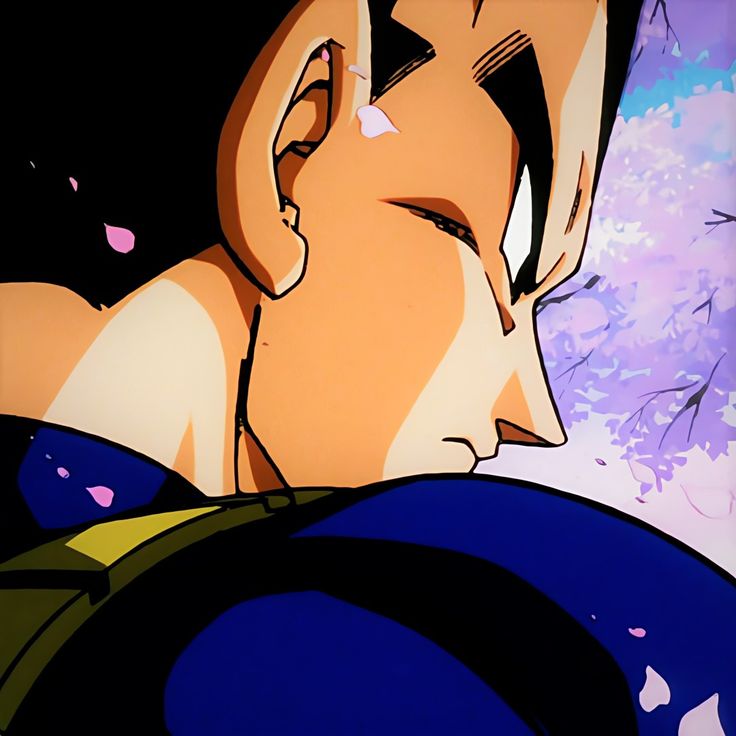
Under Bowlby and Ainsworth’s lens, Vegeta’s pride stops looking like a purely philosophical choice and starts reading as an avoidant attachment strategy built under cosmic duress.
Before he becomes the man who cannot bear to be seen, he was the child who learn, on a genocidal scale, that attachment is a liability. Frieza doesn’t just exterminate the Saiyan race; he annihilates every model of safe dependence Vegeta could have had. A prince he was, but that doesn’t mean anything good, when we remember that it actually meant that he was taken from his father, placed under Frieza’s dominion, raised inside a power structure that used his royal identity as leverage and his life as a bargaining chip. In this type of environnement, closeness became exposure real quick. Any caregivers he had (and Nappa does not count) were replaced by a tyrant who “owned” him, I don’t want to touch the subject of intimacy because the fandom did an… interesting job with that, but I can safely say that it was automatically paired with humiliation.
That’s how Vegeta grew up: Attachment to anything , a person, a hope, a version of the future, was a vector for loss or manipulation. The psyche that develops under those conditions does not learn to love carelessly. It learns to love, if at all, behind significant structural protection.

In those formative years of his, the Sartrean armor I just traced is not a “bad guy” aesthetic; it is a survival technology. Honestly, by the time Bulma and Trunks appear, Vegeta isn’t simply reluctant to love, his entire nervous system has been calibrated to treat love as the prelude to obliteration
What Bowlby tells us through her works, we can recognized it immediately within Vegeta: the hyper-independence, the rejection of comfort, the instinct to convert every vulnerability into aggression before anyone else can convert it into a weapon… these are not the behaviors of someone incapable of attachment. They are the behaviors of someone who learned, at a formative age and under extremely persuasive conditions, that attachment costs more than it returns.
However, what attachment theory also tells us (and this is the part that matters the most for Vegeta’s arc) is that avoidant patterns are not permanent sentences. They are learned, which means that with sufficient reason and sufficient safety, they can be slowly, partially, and painfully unlearned. I have to believe that for personal reasons. But in DBZ, Trunks is a sufficient reason. Bulma is sufficient safety. Of course, neither transformation is quick, clean or complete. But both are real.
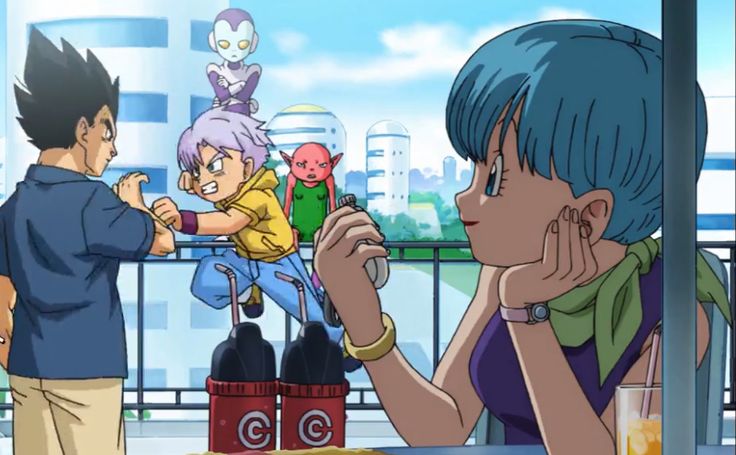
Vegeta’s armor was built for a world that no longer fully exists. It might be tragic at the heart of it but it is also the beginning of its necessary dismantling.
9 — The Narcissistic Fortress: Love as Structural Threat

I hate psychoanalysis. I know that by saying this, I sound at best, crazy, and at worst like a hypocrite since I wrote an entire article to do just that to my favorite anime character. The thing is, psychoanalysis has a reputation for pathologizing pride and I don’t like that because I think it completely miss the point with a character like Vegeta.
In the end, I think that Vegeta’s refusal of love is not a failure to evolve but the last, stubborn integrity of a man who knows what happens when you open those gates. The “Narcissistic Fortress” (borrowed loosely from object relations theory) he has built around himself, with pride, distance, contempt and the compulsive need to stay “above”, is not pathology in the clinical sense but I do think it is an architecture in the existential one.
The self becomes the thing that must be defended above all others, not out of vanity, but out of necessity. When the early environment is threatening enough, when loss and subjugation arrive before the psyche has developed the resources to metabolize them, the mind does what any rational system does under siege: it fortifies. It builds walls. It makes the interior inaccessible. It converts vulnerability into architecture.
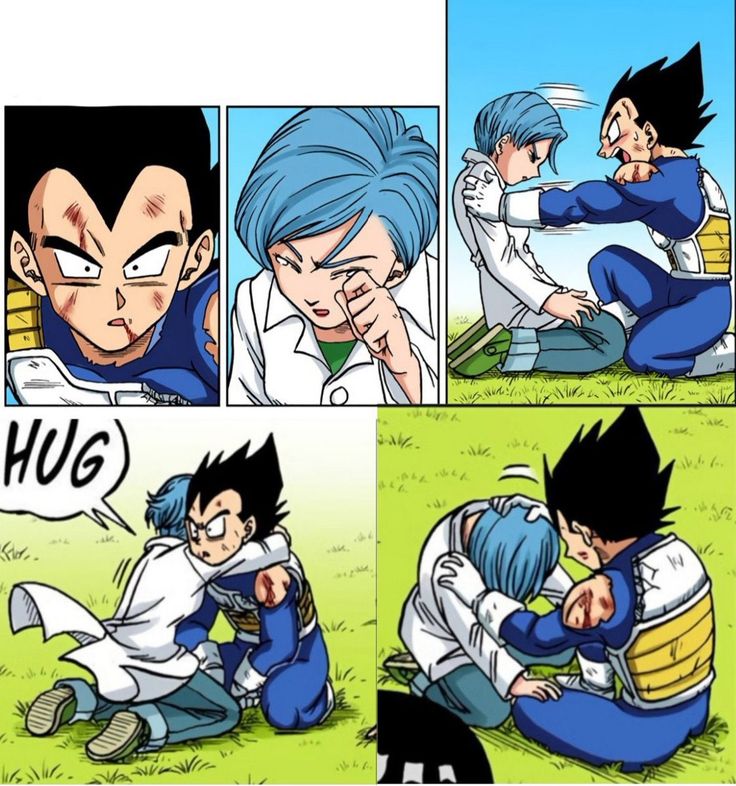
So Vegeta stages his life as a citadel: family at arm’s length, tenderness wrapped in dismissal, love expressed only in sacrifice and self-erasure on the battlefield. And yet, the paradox my whole arc has been tracing is this: it is precisely because he loves that the walls must stand so high. He is not a broken man learning, too late, how to feel… he is an unbroken one who has chosen, with terrifying consistency, how to survive.
I’ll die on that hill, Vegeta does not have pathology to explore.
He has engineering to deconstruct.
And even if some were to insist that he’s the perfect archetype of the “Narcissistic Fortress”, how can we not see it as the most intelligent response available to a child who was taken from everything he knew and placed inside a structure designed to use him? That’s not failure, that’s damage control. Yes, his armor, his citadel, his walls calcified and became a prison, almost impossible dismantle before it was too late, but that is not a moral failing, it the precise function of fortresses. They are supposed to outlast the wars that built them.

I think I’m done defending my case.
If you made it to the end of this crazy essay, I’ll leave you a bit of myself: what I have always loved about Vegeta, from the age of six, before I had any of this vocabulary and before life scratched me, is that he never stopped being the person inside the armour, inside the citadel, even when said armour and citadel were all I could see. His pride was real. His endurance was real. His reluctance to love was real. But underneath all of it, no matter how much he did not want it to be true and against every logic he had imposed on himself: his love was real too.
I’m never going to see him as a broken man who found redemption. For me, Vegeta will always be the unbroken man who found, slowly and at considerable cost, that some walls are worth dismantling yourself and choose to do it.
That is why he is my anime favorite character of all time, no matter what age I am.

I will leave you, faithful reader, with one gift:
Here is rare fanvid that is at least fourteen years old, and has been deleted from Youtube from what I could find. I had a backup because fourteen years ago, I found that video stunning and astute. It’s also a character analysis of Vegeta. I’m happy to share it with you all and let me know if you stumble upon the original so I can credit it to its rightful creator:
Did you like the article? Please leave a comment!
Explore more articles and fandoms in the “Geek Talks Series” on JGC Blog
To get to know me, the author better, you can subscribe to my Social and Follow the “Sabine Yapping Series” :)
The French translation of this article will soon be available on Substack.
Featured Header Image: Source and Credits: YemIdeas

Make a one-time donation
Make a monthly donation
Make a yearly donation
Choose an amount
Or enter a custom amount
Your contribution is appreciated.
Your contribution is appreciated.
Your contribution is appreciated.





Leave a Reply