

A Short Essay on Maladaptive Daydreaming, Internalized Racism, and the Colonization of Inner Space
I was six when I first noticed that the heroine of my daydreams did not look like me.
First, let me explain what I mean by “daydreams”. I am not talking about the soft fantasy of a school afternoon. I mean maladaptive daydreaming: a phenomenon first named in 2002 by the psychologist Eli Somer, in which a person spends hours each day inside immersive, plot-driven fantasy worlds, sometimes with the same characters they have lived with for years. For some of us, it is a coping mechanism. For some of us, it is the only place where the world cannot reach, it’s the best comfort possible.
Fair warning, this is, to date, the most vulnerable piece I ever written. For most of my childhood, that place was the most precious thing I owned.
I grew up in Brest, on the western edge of France. From kindergarten through ninth grade, I was the only Black child in my school. Not the only one in my class. The only one in the school. There is a particular weight to that geometry. You become, for everyone around you, the exception that confirms the rule. You become the figure that whiteness takes for granted. And you learn, very early, that the inside of your head is the only place where the rule does not reach.
Or at least, that what I thought.
Let me be raw about something I had not written with this much clarity before. The heroines of my daydreams, for years of my life, did not look like me. Their skins were lighter. Their hair fell differently… or simply fell. Meaning no afro. The plots my imagination built around them rewarded them in ways the world had taught me to associate with whiteness. They were chosen, pursued, defended. They were the protagonists in a way my body had been told it could not be, and not just by society.
I want to be careful here, but quite frankly, not to careful.
This is not a story about White people. This is my story about what whiteness does to a Black mind raised inside its perimeter. The two are related, but they are not the same.
Me, a Black child raised in Brest learning whiteness the way fish learn water: not by soft immersion but by inevitable circumstances.
From three to thirteen years old, being Black was the first thing that defined me to everyone around me outside of my family. No need to look further, who I was, who I could be and who I was supposed to become, was right here, painted on my skin. I remember being very little, in Kindergarten, on picture day, and hearing the photographer gushed about how great it will be to put me in the middle of the group picture, for the aesthetics. Like I was the exotic ornament and in this scenario, the unique object that would underline something I couldn’t name. Then, to add insult to the injury, he physically picked me up, and placed me on the giant yellow rainbow toy. He picked no other child. He asked them where they wanted to go, if they wanted to be paired with their best friend and then, placed them to everyone’s liking. Me? No need to ask for my opinion, no need to even address me directly. I was a decoration not a child.
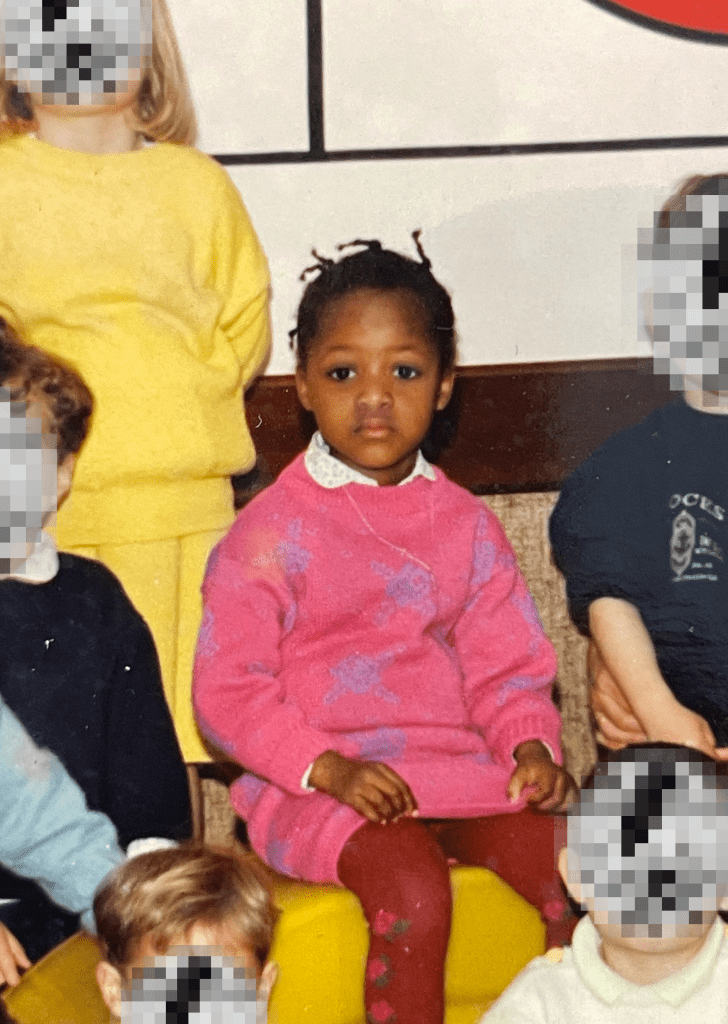
When I look at the picture above, I ache. My mom dressed me very carefully that day, in pink and red, and she gave me a necklace that meant a lot to her, a necklace I lost the same day. She wanted me to feel pretty. I think I knew even before she dolled me up, that it was an impossible wish.
What I want to name, as precisely as I can, is this: internalized racism can reach into and corrode the imagination. It does not stop at the surface of the body. It does not stop at the school photo where you are the only one. It enters the most intimate room in your psychic house, sits down on the bed, and starts rewriting the script you thought was yours alone.
I would say there is a particular bile to that recognition. The bile of self-rejection is more intimate than the bile of being rejected by others, because no one needs to do the rejecting. The rejection has already been outsourced to my own imagination, which was, for me, the place I most trusted not to betray me.
W. E. B. Du Bois, in 1903, called this double consciousness : the sense of always looking at oneself through the eyes of others, of measuring one’s soul by the tape of a world that watches you with amused contempt and pity. I spent the first two decades of my life plowing under this particular defect and the next decade, the one I’m in, trying to destroy this inner poisoned structure.
Frantz Fanon, in Black Skin, White Masks, described the moment a Black child discovers themselves in the mirror of the White gaze and finds the image already distorted before they can claim it. Sartre, more abstractly, described being seen as the moment the world steals your subjectivity from you: Le regard. I honestly cannot pinpoint a time I didn’t feel like this, like the stereotypes and negatives connotations White people were sticking to my skin color, did not impact the way I was thinking and viewing myself. When the gaze comes for you inside your daydreams, you have nowhere left to retreat. I feel like that distortion almost came in the pre-settings of my life, like there were simply… no other way for me to coexist in the city and country I was born into.
I do know one thing for sure: that memory of picture day was not the first time I felt less human than anyone else, like I was nothing.
Writing this article, creating a brand for my blog, being more honest and transparent about the scars life left on me, filming myself, watching myself speak, appreciating the shade of my skin, my hair, my smile, maintaining my therapy sessions, journaling, reading, researching, learning… all of those things are part of a very painful and complicated healing journey. It is also the acceptance that what happened to me is something to fight back, something to resist. bell hooks called the act of resistance the oppositional gaze and her analysis truly helped me understand how to question the toxic inner voice that developed with me, day by day, years after years.

But extracting myself from maladaptive daydreaming and realizing what my mind was doing felt like a punch in the gut. For years, I did not know this was happening. I just knew the protagonist of my fantasy was someone I would never become, and I never asked why.
The naming came late. It came through reading. It came through writing. It came through one specific evening, when I stopped mid-fantasy and asked myself, plainly, what does she look like? Ironically, I was distracted by picturing the father-figure character of a beloved book and wishing I was the daughter, when it hit me: the father was White. I’m… what? I’m Black in real life but I’m never Black in my dreams… not White either, right? Oh God, what do I look like in my head? Why do I look like that in my head? I tried to answer the question honestly. The face my own imagination handed me was not mine. It was nobody I knew. It was a composite of every magazine cover, every romantic-comedy lead, every nineties heroine whose hair fell into her eyes when she looked up. I sat with that face for a long time. The room I had built to escape into was not, after all, mine.
The more I write this essay, the less I care about being careful. I do not say this to indict the books I read, the films I loved, the heroines I admired. I say it to name the silence around me, the absence of mirrors, the geography of being the only one.
A child cannot daydream herself into characters that have not been written, faces that have not been given to her, names she has not heard. The colonization of my inner space, I think, is in part a problem of supply. But it is also a problem of demand. We learn what is worth fantasizing about. We are taught who is allowed to be the protagonist.
Another part of the problem is that the characters that were worth fantasizing about were not only White, they were happy. I wasn’t. Not at school, not at home. And for the longest time representation offered me no Black characters that were happy.
The reclamation of this is slow. But I know that it is also possible.
I no longer write protagonists who do not look like me unless I am doing it on purpose, as a literary choice, with full awareness of the choice. The Black girls and women I now place at the center of my imaginary worlds are not, exactly, reparation for the younger me. They are inheritance. They are what I owe forward, to the Black girl in Brest in 2026 who is reading something I might one day write, and who deserves to find herself on the page without having to translate.
All of this is so messy and hard. There is no clean victory I can deliver to you. Internalized racism does not lift in a moment of insight, at least that’s not what happened for me; No, mine thins, slowly, over years, the way fog thins as you walk through it. I catch myself. I name it. I choose differently. And then, sometimes, I catch myself again. The watchfulness is the painful work.
The most insidious thing internalized racism does is not what it does to your eyes. It is what it does to your imagination and you cannot decolonize a mind that does not know it has been colonized.
So here is what I am offering today to anyone who can unfortunately relate to my essay: imagine the small map of one room in one house. If you are a Black woman or man, or any racialized person, who has caught yourself in the mirror of your own daydream and not recognized the protagonist, you are not alone. The fact that you noticed is the first inch of your reclamation. The fact that you can name what you saw is the second.
I was the only Black girl in my school, yes, but I am no longer the only Black girl in my imagination. And never again will I self-erase.
Keep going. Keep noticing and choose your protagonists.
The world might not want to offer me a safe reflection, but it doesn’t matter because I am my own multitude.
—
**TL;DR**
– A Black woman writes about maladaptive daydreaming and the way internalized racism reaches into the imagination itself
– The colonization of inner space is not figurative: the heroines of one’s own daydreams can be unrecognizable to oneself
– Du Bois, Fanon, bell hooks, Sartre give the framework; the experience of growing up the only Black child in a French town fills it
– You cannot decolonize a mind that does not know it has been colonized; naming the daydream is the first inch of the reclamation
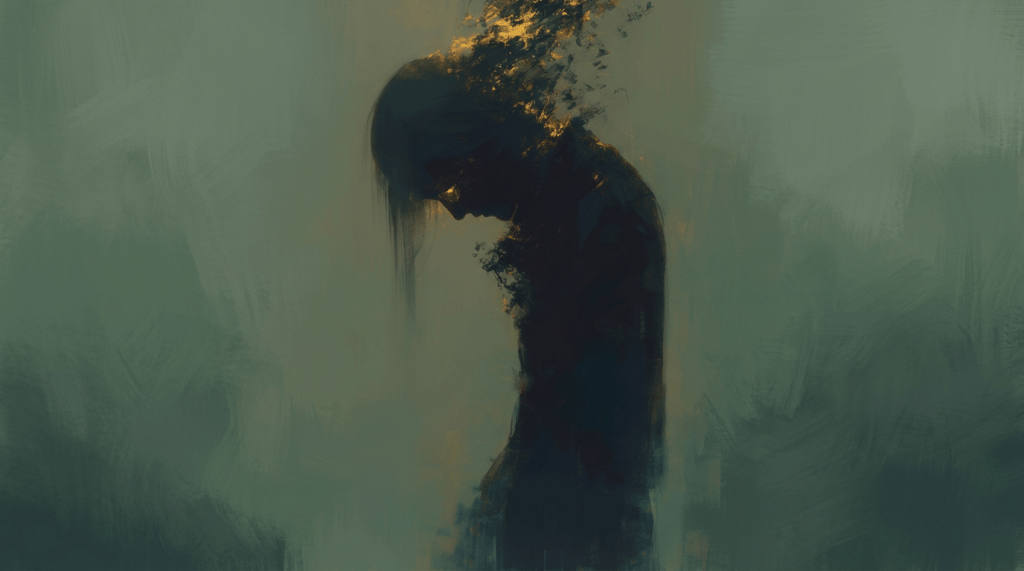
- Featured Image Header: Jabari Timothy, please support the artist on his page.
Did you like the article? Please leave a comment.
Explore more articles and reviews in the “Cultural Thoughts: Letters and Essays” on JGC Blog
To get to know me, the author better, you can subscribe to my Social and Follow the “Sabine Yapping Series” :)
The French translation of this article is available on Substack.





Leave a Reply